
What is ETL Testing?
ETL testing verifies that an ETL process accurately extracts, transforms, and loads data according to the specified requirements. It validates and compares the generated output with the input data to ensure consistency.
Why is ETL Testing Required?
- Ensures data accuracy and integrity post-transformation.
- Identifies and resolves data issues early in the development lifecycle.
- Prevents costly data quality issues in production environments.
ETL Testing Concepts
- Static ETL Testing: Compares output data to predefined fixed values or conditions.
- Dynamic ETL Testing: Compares both input and output data, accounting for runtime variations.
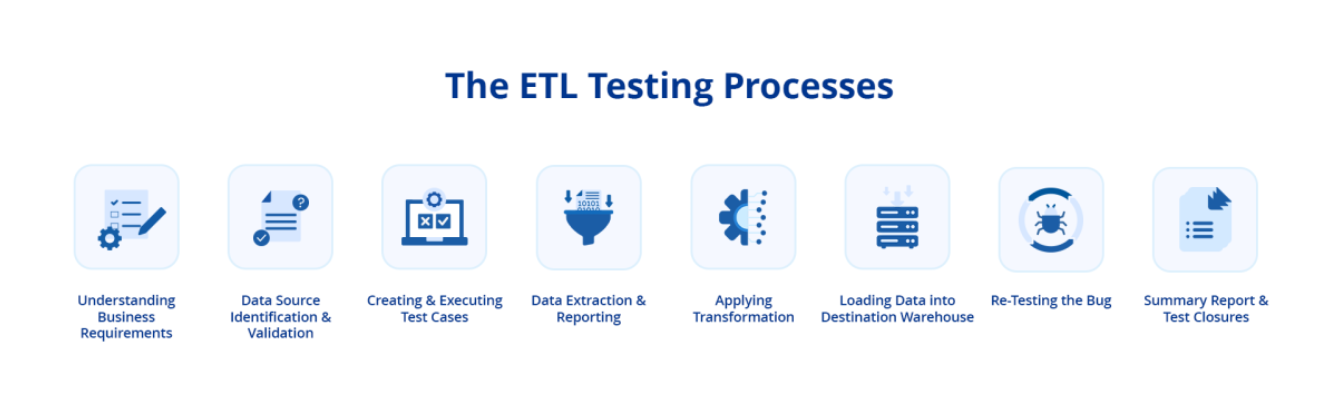
Types of ETL Testing
- Source Data Validation Testing
- Source to Target Data Reconciliation Testing
- Data Transformation Testing
- Data Validation
- Referential Integrity Testing
- Integration Testing
- Performance Testing
- Functional Testing
- Unit Testing
- Validation Testing
Manual vs Automated ETL Testing
Manual ETL testing is resource-intensive and prone to human error. Automated ETL testing provides:
- Repeatable and consistent test execution.
- Scalability for large data volumes.
- Faster issue identification and resolution.
Benefits of Automated ETL Testing
- Automated test case creation and execution.
- Comprehensive data validation across systems.
- Integration with test management tools.
- Support for both static and dynamic approaches.
- Enhanced data quality and reliability.